Agentic Transformation Approach · prepared for Convera
Convera Agent Workbench

From scattered use cases to an integrated agentic portfolio.

How Convera operates, powered by Lyzr — multi-agent workflows, policy-grounded compliance, value streams that compound.

Start the walk-through →
Pilot lead: KYC / Onboarding Deployment: Convera AWS VPC Method: Crawl · Walk · Run
WHERE CONVERA IS TODAY

Three realities shaping Convera's agentic moment.

The use cases have been identified. The competitive context is clear. What's needed now is the connective tissue — the framework, the engineering muscle, and the platform that turn scattered experiments into a portfolio that compounds.

Reality 01

Multiple agentic experiments are underway. They don't add up yet.

Bedrock, UiPath, Camunda, Agentforce, MCP, Resolve AI — each doing its job. None of them is the layer that turns the collection into an integrated agentic capability.

Discovery signal

"It's like a blank canvas at the moment for us, and that actually is quite intimidating because of just all of the options that we have to be able to consider where to start, what to do."

— Convera operations leadership · discovery call, May 2026

Reality 02

Use cases are easy to find. Sequencing them for compounding value is the hard part.

The work isn't identifying more candidates. It's building each one so the next inherits the knowledge graph, the tool registry, the governance pattern.

Discovery signal

"If we approach it from the use case point of view, literally we will throw one rock and we'll hit multiple really really straightforward ones. The questions in order to do that are around framework and strategy."

— Convera operations leadership · discovery call, May 2026

Reality 03

Meanwhile, the operational drag is real — and peers are already moving.

Weeks-long onboarding, payment exception backlogs, twenty FTE on beneficiary data. At the same time, AI-first specialists are reshaping the category.

Competitive context

Flywire (Q1 2026): 40% admin inquiry reduction · 20% faster payment processing · AI moat framework named

Payoneer (FY 2025): "AI-first orientation" cited · 21% ARPU growth · 3% opex reduction with higher volumes

Corpay (Apr 2026): AI Virtual Assistant launched in Corpay Complete

SOLUTIONS

The workbench is the partnership. Consulting and engineers are how we make it land.

Lyzr is an agentic AI company. The product — a Convera-specific agentic workbench — is what compounds across the portfolio. Consulting frames the work and engineers ship it; both exist to make sure Convera gets full value from the workbench, not to sell services around a platform.

Core · the product

The Convera Agentic Workbench

A single canvas where Operations, ObsTech, Compliance, and Product see agents in motion, approve decisions, and govern the portfolio. Multi-agent execution, policy-grounded compliance, traceable audit — the operating system Convera builds on, not maintains alongside.

Agent Decision Inbox Every action human-reviewable and audit-ready.
Multi-agent canvas Value streams, agents, orchestration in one view.
Governance built in Simulation, CISO workflow, observability.
Sub-account isolation Each function owns its own environment.

Enabler · Consulting

Frames the portfolio

Agentic transformation consultants who work with your organization, speak to all users, unlock tribal knowledge, and build business cases, adoption plans, and change management plans.

Enabler · Applied AI

Owns end-to-end outcomes

Full-stack outcome team — agent engineers, UI/UX designers, data architects, cloud architects, security architects, full-stack developers. Not vendor support; an extension of your team.

Enabler · Training

Builds your self-sufficiency

Internal enablement that trains Convera's teams to build faster on the platform. The goal is your self-sufficiency, not permanent dependency on us.

The integration claim

One product. Three enablers. Concurrent throughout.

The workbench is what compounds. Consulting, Applied AI, and Training ensure Convera realizes the compounding — not as sequential phases, but as concurrent capabilities.

Pillar 03 · in depth

The workbench compounds.

A single Convera workbench where value streams live as canvases, agents execute as multi-step flows, and human decisions are captured in an inbox — every action traceable, every approval governed.

Schematic · Convera Agentic Workbench · KYC value stream Indicative UI
Convera × Lyzr Workbench
Plan Build Orchestrate Govern Ship

Execution · agent build pipeline

01

Brief

Scope & success

02

Connect

Data sources

03

Design

Multi-agent arch

04 · Active

Compliance

Policy grounding

05

Simulate

Sample data test

06

QA

Accuracy bench

07

Deploy

Sandbox → prod

08

Monitor

Observability

Modes

Connect
Amplify
Orchestrate

Workflow

KYC / Onboarding

Active moment

Customer onboarding — Applicant #C-4829

01 Document intake & extraction Complete
02 Data validation & reconciliation Complete
03 Onfido IDV — handoff Complete
04 AML / sanctions screening Active
05 Compliance summary & flagging Pending
06 Human review & sign-off Pending

Decision Inbox 3

Onboarding #C-4829

AML screening · 2 min ago

PEP check Watchlist match

Payment exception #PE-2104

SWIFT routing · 12 min ago

Currency: SGD→GBP

Beneficiary update #B-9851

Account verification · 24 min ago

IBAN validated

Element 01

Value streams

Each Convera workflow as a continuous canvas. Operations, Compliance, Product see their domain organized.

Element 02

Multi-step agent flow

Each customer or transaction moment runs as a sequence of agents. Status visible. Onfido and other partners stay where they are.

Element 03

Decision Inbox

Every agent decision requiring human approval. Traceable, governed, audit-ready. The crawl-walk-run pace lives here.

ENABLERS

Technology alone won't get you there.

The workbench compounds value over time, but only if Convera's teams know how to use it, what to build on it, and how to keep building once Lyzr's engineers step back. Three enablers ensure the platform becomes a Convera capability — not a Lyzr dependency.

Enabler 01 · Consulting

Frames the portfolio.

Agentic transformation consultants who work with Convera's organization, speak to all users, unlock tribal knowledge, and translate the agentic agenda into business cases, adoption plans, and a sequenced portfolio. Three analytical artifacts shown below — already produced for Convera during discovery — illustrate how consulting partners with leadership through every engagement.

Artifact 01 · scoring rubric

Three independent dimensions per use case

Operational impact, technical feasibility, platform leverage — scored 1 to 5. The third axis is the difference between point automation and an integrated portfolio.

Methodology
Three-dimensional scoring rubric for use cases

Artifact 02 · candidate use cases — scored

Where each use case lands across the three dimensions

Anchored candidates named directly in discovery. Derived candidates surfaced from Convera's operating profile. Each scored against the rubric to surface the genuine prioritization signal.

Output
Candidate use cases scored across three dimensions

Artifact 03 · wave structure

Sequencing the portfolio for compounding value

Use cases placed against process standardization and operational drag. Wave 1 establishes platform foundations; subsequent waves inherit. The sequencing is the integrated portfolio.

Sequencing
Wave structure 2x2 prioritization matrix

Enabler 02 · Applied AI

Owns end-to-end outcomes.

A full-stack outcome team embedded into Convera's organization. Not vendor support — an extension of your team that ships agents to production.

We bring the disciplines — Convera owns the outcome. Every agent ships to production, not to a roadmap.

The team builds, simulates, and deploys agents on the workbench. They report into Convera's structure and operate alongside your existing teams — not parallel to them.

Agent engineers & full-stack developers Build the multi-agent workflows that run on the workbench.
Data & cloud architects Integrate with Convera's existing stack — Bedrock, UiPath, Camunda — and design for scale.
UI/UX designers & security architects Make agents usable by Convera teams and reviewable by CISO from day one.

Enabler 03 · Training

Builds your self-sufficiency.

Internal enablement designed so Convera's teams can build, deploy, and govern agents on the workbench without us. The goal is your independence — not permanent dependency.

Knowledge transfer is built into the engagement, not added at the end. From day one, Convera teams work alongside Lyzr engineers on every agent.

Training operates on two horizons — immediate (working sessions on each agent during the engagement) and structured (curriculum for operations, ObsTech, product, and compliance teams who'll own the platform).
Pair-build sessions Convera engineers and operators co-build agents during the engagement. No black boxes.
Workbench enablement curriculum Role-specific training across builder, reviewer, and governor personas.
Architect for everyone The vibe-coding agent prototyping tool open to broader Convera teams — pipeline of ideas expands beyond engineering.
ARCHITECTURE

A layer above the existing stack, not another tool inside it.

Convera's existing investments — Bedrock, UiPath, Camunda, Agentforce, MCP, Resolve AI — were assembled for distinct purposes and are fit for those purposes. What is missing is the layer above them: orchestration, memory, policy enforcement, governed workflow intelligence. That layer deploys inside Convera's AWS VPC.

Differentiator 01

Advanced memory management

Lyzr's memory architecture is what other platforms underbuild. Convera's workflows are stateful — onboarding sessions, payment investigations, support conversations all need persistent context across agents and time.

Differentiator 02

Cross-framework orchestration

The workbench orchestrates agents whether they're built on Lyzr, LangChain, Crew, or Agentforce. Existing Agentforce experiments and Bedrock work don't get scrapped — they get registered, governed, and conducted through one plane.

Differentiator 03

Open posture, no lock-in

Lyzr is open-source-first. Git Agent and Open GAP make every Lyzr-built agent portable. The platform deploys inside Convera's AWS VPC — your data never leaves, your agents are yours.

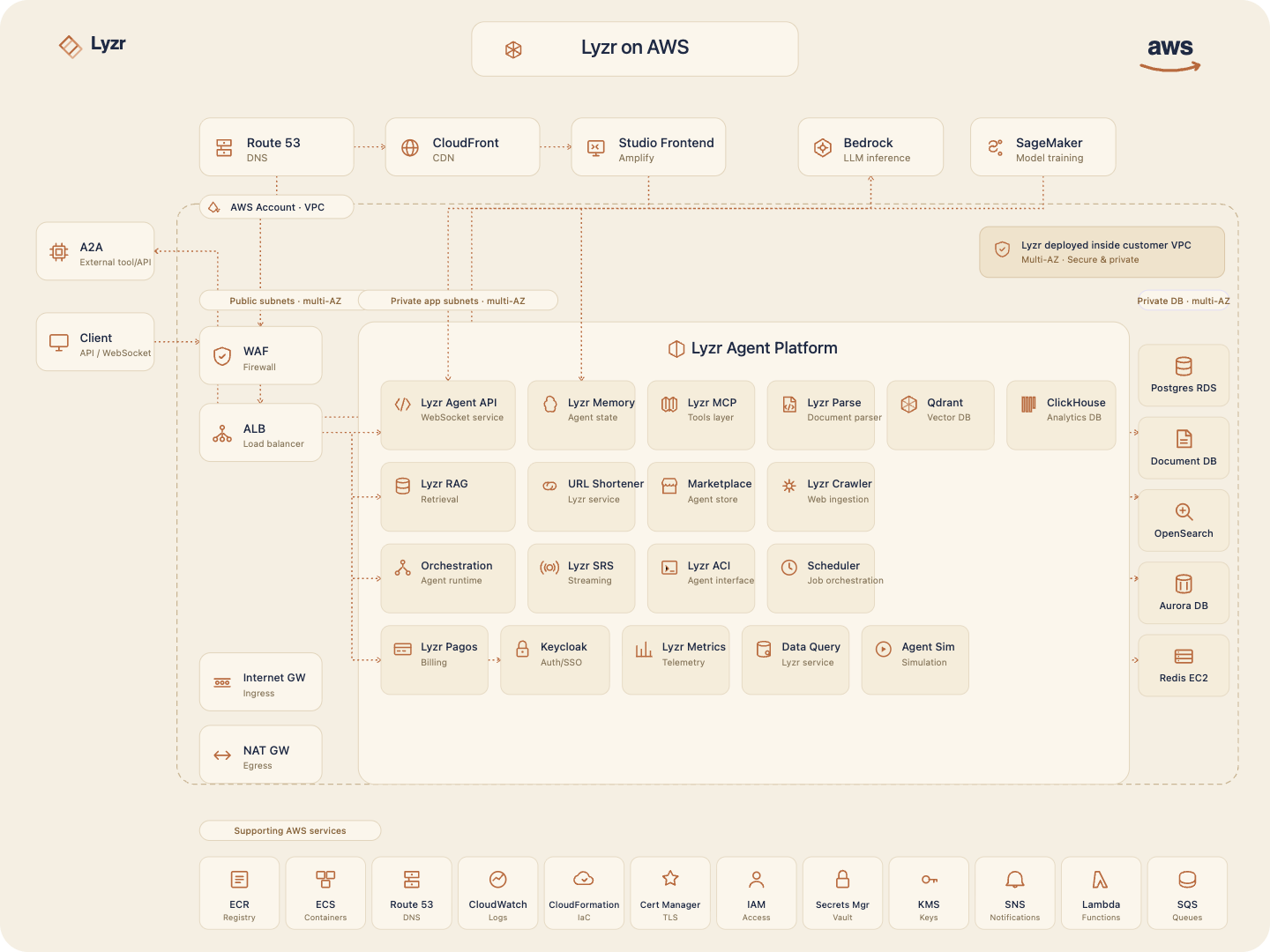
Lyzr Enterprise Studio · production deployment topology Reference architecture
Lyzr on AWS architecture
Deployed inside Convera's AWS account · VPC-isolated · multi-AZ · WAF + ALB at the edge · private DB subnets for Postgres, Document DB, OpenSearch, Aurora, Qdrant, Redis · Bedrock and SageMaker for foundation model and ML workloads · full audit and observability via CloudWatch, IAM, KMS, Secrets Manager.
GOVERNANCE & COMPLIANCE

Two questions a business audience really asks.

Will an agent make a decision a human should make? And how do we know what the agent did? The maturity ladder answers the first. The four-artefact audit trail answers the second. Together they make the workbench safe to deploy in a payments and compliance environment — across every use case in the portfolio.

Question 01 · Will an agent make a decision a human should make?

A calibrated autonomy ladder, mode by mode.

Every agent in Convera's portfolio operates at a specific level of autonomy. The mode is workflow-specific — set during build, enforced at runtime, recorded in the audit trail. High-stakes decisions stay with humans; routine work scales without them.

Mode 01

Assist

AI suggests · Human decides

The agent surfaces context, drafts a recommendation, or compiles an analysis. The human reads, decides, and acts.

Example: regulatory monitoring agent surfaces a flagged policy change for the compliance team to review.

Mode 02

Co-pilot

Agent drafts · Human approves

The agent prepares decisions, screening outcomes, or proposed actions. The human approves before execution. Every approval is logged.

Example: KYC onboarding, AML / sanctions screening, payment exception triage. Most Convera workflows start here.

Mode 03

Semi-autonomous

Bounded execution · Human reviews exceptions

The agent executes within explicit policy guardrails. Routine cases proceed; edge cases are flagged for human review.

Example: beneficiary data movement, reconciliation routine, low-risk transaction matching.

Mode 04

Autonomous

Full orchestration · Human audits

Agents act within policy without per-action approval. Humans audit by sampling and pattern, not by checkpoint.

Example: reserved. Promoted only when audit history and operational confidence justify it.

Question 02 · How do we know what the agent did?

Four artefacts. One audit trail.

Every decision an agent makes — at any mode, for any rule, across any use case — is backed by four on-disk artefacts an internal auditor, a regulator, or an operations leader can open, read, and re-run. Nothing is computed in memory and thrown away.

01

Pre-check

Every rulebook, fresh and on the record.

Before any rule fires, the workbench confirms it's the current version the agent will reason against — so an action is never checked against stale guidance.

Across use casesSanctions lists, KYB jurisdiction rules, AML thresholds, internal policy documents, regulatory guidance updates — all fetched, version-tracked, and refreshed before the agent reasons.

02

Ledger

Each rule, a clear verdict and a suggested fix.

Every rule the agent checks produces a verdict in plain English — what the rule says, what tripped, exactly what to change. The reviewer reads it; no decoding required.

Across use casesSanctions screening match with cited list and entity. KYB document missing with the specific jurisdiction's requirement. Beneficiary mismatch with the source and destination records. Each verdict carries a confidence score and a recommended action.

03

Audit trail

Every decision, in order, never rewritten.

Every flag, every escalation, every human override lands on one timeline. Re-runs append — nothing is mutated in place — so the trail tells the same story to the operator today and the auditor next quarter.

Across use casesAgent flagged. Routed to reviewer. Reviewer applied a fix. Agent re-ran. Outcome cleared. Every entry timestamped, signed by the action's source, and immutable.

04

Handoff

One audit pack, stapled to the record.

When an agent action completes, the workbench bundles a tamper-evident audit pack and hands it off to Convera's existing systems of record. The evidence travels with the customer, the transaction, or the case — ready for internal review or regulator request without an email thread.

Across use casesKYC onboarding completes — the audit pack lands in the customer record. A payment exception resolves — the pack attaches to the transaction. A reconciliation closes — the pack joins the finance close evidence. Same pattern, every time.

"

The non-negotiable

Agents orchestrate across systems of record. They never become systems of record.

The workbench reads from and writes to authoritative systems — SWIFT, Salesforce, payment engines, compliance databases, Convera's customer record. It holds no canonical state itself. Auditability stays in the systems of record; agents enrich, orchestrate, and hand off. This is the architectural commitment that makes the four artefacts trustworthy — and the autonomy ladder safe at every mode.